
In 2026, the FIFA-to-EA FC transition has settled into a comfortable rhythm, but seasoned players still shudder when they think back to the chaotic season that was EA FC 25. What began as a bold new chapter for the world\u2019s biggest football sim quickly spiraled into one of Electronic Arts\u2019 most expensive cautionary tales. To understand how a single game managed to punch a $500 million hole in the publisher\u2019s earnings forecast, you have to rewind to early 2025, when the front office started sweating bullets over disappointing holiday numbers.
Even back then, EA\u2019s four-star review of EA FC 25 had described it as a game \u201cwaiting to reach its potential\u201d \u2013 and nearly four months post-launch, it felt like it was still stuck in the tunnel. Matchmaking meltdowns, scripting accusations, and invasive network hiccups made every weekend league feel like a lottery. Hardcore grinders complained about a suspected clampdown on community-driven trading rules, while casual fans simply got tired of the inconsistency. Yet there was a glimmer of hope: Tile Update 8 was released to widespread applause, with many calling it the best patch in franchise history. The responsiveness, the dribbling tweaks, the long-overdue nerfs \u2013 for a brief moment, the game actually felt like a love letter to football. Unfortunately, that gameplay high came way too late to rescue the bottom line.
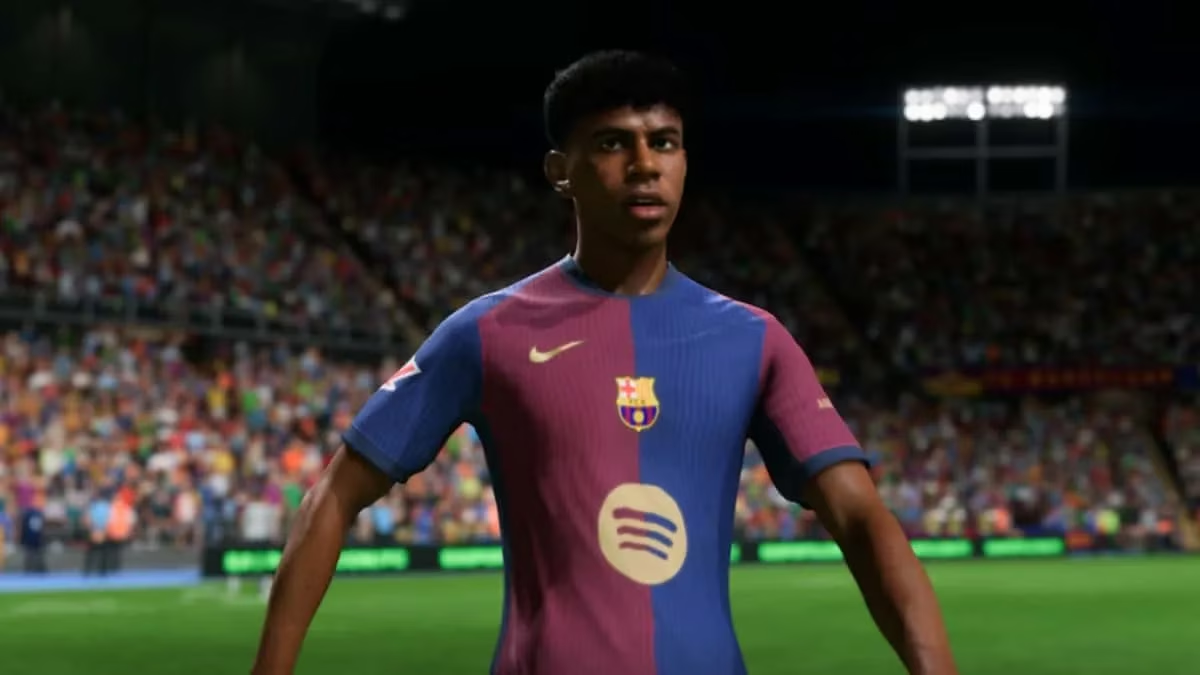
On January 22, 2025, EA dropped a bombshell that sent investors scrambling. The company slashed its projected net bookings for the fiscal year from a healthy belt of $7.5 billion\u2013$7.8 billion down to a sobering $7.0 billion\u2013$7.15 billion. That roughly half-a-billion-dollar haircut, first flagged by Bloomberg, left no room for sugar-coating. In the official statement, the lion\u2019s share of the blame was pinned directly on the struggling EA FC 25, which had underdelivered not just in unit sales but crucially in live-service spending \u2013 that golden goose of Ultimate Team packs and cosmetic microtransactions. The previous quarter\u2019s actual bookings landed at $2.22 billion, woefully short of the $2.4\u2013$2.55 billion target, and a large chunk of that miss could be traced back to players who simply refused to open their wallets for promos they didn\u2019t trust.
To make matters worse, EA\u2019s other festive season gamble had also backfired. Dragon Age: The Veilguard, BioWare\u2019s long-awaited RPG, managed to gather 1.5 million players between its October 31, 2024 launch and the end of the financial quarter on December 31, 2024. That figure missed internal expectations by around 50%, a shortfall amplified by the game\u2019s notoriously troubled development cycle and pre-release backlash from lore purists. So EA was effectively nursing two black eyes at once \u2013 an undercooked sports titan and a fantasy epic that couldn\u2019t find its footing.
Yet amid the rubble, CEO Andrew Wilson kept his eyes on the horizon. \u201cWe remain confident in our long-term strategy and expect a return to growth in FY26, as we execute against our pipeline,\u201d he assured analysts. For a player scrolling through social media at the time, that promise sounded like corporate boilerplate. But looking back from the vantage point of 2026, those words proved oddly prophetic. The lessons from the FC 25 fiasco were not wasted. EA FC 26 launched with a far more stable server architecture and a revamped feedback loop that actually listened to pro players and creators. The aggressive monetization dialed back a notch, replaced by more generous reward trajectories and transparent pack odds that started to rebuild the trust that had evaporated the year before. The result? A slow but steady climb back toward the growth Wilson had promised.
The 2025 earnings shock still echoes through EA\u2019s boardrooms, serving as a permanent reminder that even a franchise generating billions can stumble if it loses sight of its community. Here in 2026, with EA FC 26 comfortably past its halfway mark and the buzz already building for the next iteration, the mood is far more optimistic. But nobody forgets that cold January day when a single \u201cdown year\u201d of virtual football wiped $500 million off the table. For the game\u2019s enormous global fanbase, it was proof that no amount of licensing deals or shiny HyperMotion technology could substitute for the fundamentals: a game that works, a pitch that feels fair, and a developer that actually hears your screams when your centre-back decides to ignore a loose ball in the box.
The picture that really captures that period isn\u2019t a spreadsheet or an earnings call transcript. It\u2019s a blurry, deleted social media post from Barcelona prodigy Lamine Yamal, cheekily requesting a new Playstyle in EA FC 25. That single image summed up the sentiment of millions of players: the game had potential, but it needed a new trait \u2013 maybe something like \u201clistens to feedback.\u201d In 2026, that trait finally seems to be getting added to the franchise\u2019s core DNA.